Tuesday, 23 February 2016

People Are Kind of Scared About This Mark Zuckerberg Photo

CEO Mark Zuckerberg shared a photo on his Facebook profile that’s caused quite a stir online.
In the photo (which you can view below), Zuckerberg can be seen walking through an audience of people hooked up to virtual reality headsets at the Mobile World Congress, a tech conference, in Spain. Zuckerberg made a surprise appearance to talk about Samsung’s Gear VR and hinted at Facebook working more closely with Samsung in the future.
Zuckerberg is slated to give his own keynote address on Monday,which you can read more about on Fortune.
The photo, which was posted on Sunday, has since garnered over 55,000 likes and over 15,000 shares.
“Damn, It’s kind of creepy,” wrote the top Facebook comment on the photo. “Mark—doesn’t it feel strange to be the only one walking with your real eyes, while everyone else are zombies in the matrix?” wrote another.
Here’s the photo and some of the commotion it’s caused on Twitter:

Friday, 25 December 2015

Tears in many eyes as fire gutted a gas plant in Nnewi, at 100 confirmed burnt (graphic pictures) viewers advised

Explosion-kills-four-in-southern-Ghana-e1416664405808


59
87
It was a sad moment for  residents of the industrial town of Nnewi, Anambra State as over 100 people were reported to have been burnt  to death due to gas plant that exploded, which occurred at Inter Corp Oil Limited (an LPG gas plant).
It was gathered that the inferno, which started at about 11 am, was caused by an explosion which occurred when a truck attempted to discharge its contents without waiting for the mandatory cooling time while customers were said to be refilling their gas cylinders at the same time.
Those affected by the incident were people at the gas plant as well as neighborhood and passersby
Source gathered that burnt remains and other badly burnt people were rushed to the Nnamdi Azikwe University Teaching Hospital (NAUTH), Nnewi, while the heavy inferno did not allow rescue workers gain assess into the factory where the majority of the victims alleged to be up to hundred, were trapped.
Apart from the lives lost to the inferno, many buildings and over 50 vehicles around the gas plant were equally affected and some dead victims were said to have been recovered from their homes.
When the fire fighters from Awka and Okpoko finally arrived, it took the intervention of the security agents to save them from being lynched by the angry mob who questioned why Nnewi fire service was not functional. A combined team from the army, Federal Road Safety Corps, (FRSC), police and vigilante had a hectic time dispersing the surging crowd.

Thursday, 24 December 2015

The Fundamentals of Successful Thinking

The Fundamentals of Successful Thinking
The simple truth is that our control over our consciousness determines the quality of our lives as well as our ability to reach our full potential.
People who have developed the right mental disciplines make more money, stretch their abilities more than their peers, enjoy higher positions at work, command more respect and form more meaningful professional and personal relationships.
Conversely, those who cannot control their thoughts fight inner battles that sabotage their abilities for focused work and clear thought. Thus, they damage their earning capacity and, until change is recognized, hinder their overall competency, focus and professional progression.
Because our inner-monologue is paramount to our ability to succeed at work, it’s important to further analyze the benefits of improved mind control, how thought process affects our ability to lead as well as touch upon workable strategies in order to start cultivating a successful frame of mind.

The Benefits of Improved Mind Control

It’s hard to overstate the value of changing your thinking. Only when we are able to filter out self-defeating thoughts (i.e. focusing on what is not possible) can we begin to realize the benefits that are derived from improved mind control.
In conjunction with heightened creativity, awareness and revenue generating potential, the rewards for positive, successful thinking include:
1. Resiliency. Successful thinkers are more likely to transform hopeless situations into challenges to be overcome.
2. Intuition. Successful thinkers are able to set aside daily distractions and mental clutter and see beyond their own point of view.
3. Learning Capacity. Controlled thinking allows one to reflect upon and learn from past successes and failures in a nonjudgmental, thus productive manner.

Change in Thought Process in Relation to Leadership

For managers and aspiring future leaders, our recruiters have seen that controlled thinking propels leadership acumen in numerous ways including:
– Allows a person to see a vision and in a clear, compelling manner convey those goals to their subordinates.
– Allows a person to more successfully and confidentially anticipate any upcoming challenges.
– Allows a person to seize opportunities when the timing is right.
Beginning the Transformation
All changes in mindset come from the acknowledgement that power to transform your thinking comes from you.
1. Take responsibility. The sooner you learn to take responsibility for the choices you make, the thoughts you have, and the attitudes you embrace, the sooner you can have the life you want.
2. Invest yourself in whatever you do. Often, feelings of boredom, being overwhelmed or allowing negative thinking to filter in our consciousness will make a person detach from daily work duties. Once the individual detaches, they leave themselves open to thoughts that are counterproductive. Beginning to take pride in each and every thing that you do will go a long way to cultivating a mindset conducive to success.
3. Dream one size bigger. By pushing yourself to dream more expansively, to imagine your organization as one size bigger, to make your professional goals at least a step beyond what makes you comfortable, your mental prowess will be forced to grow.
4. Learn continually. Never be satisfied with what you already know. Part of cultivating a successful frame of mind entails consistently meeting new people, learning new skills, reading new books and engaging with others who can do things you cannot.
Practice, Repetition and Dedication – It is not enough to know how to cultivate a successful frame of mind. Knowledge is of little benefit without the discipline and unrelenting desire to implement that knowledge.
In order to cultivate a thought process that promotes success and fosters achievement, one must practice consistently in the same way that athletes or musicians practice their craft.

In the End

The truth is that the human mind has enormous untapped potential. In order to achieve our goals, it is imperative to learn how to tap into these reserves and leverage them in order to have a better career and more fulfilling personal existence.

UNFOLDING THE LONG AWAITED (PRESIDENT BUHARI'S 2016 BUDGET ADDRESS)

_n
I am honored and privileged to present the 2016 Budget proposal. This is my first address before this joint session of the National Assembly. I have come here today, not only to address members of the National Assembly, but also to speak directly to the men and women who placed us here.
2. I know the state of our economy is a source of concern for many. This has been further worsened by the unbridled corruption and security challenges we have faced in the last few years. From those who have lost their jobs, to those young people who have never had a job, to the people in the North East whose families and businesses were destroyed by insurgents, this has been a difficult period in our nation’s history, lessons that we must not forget or ignore, as we plan for the future.
3. By June 2014, oil prices averaged $112 per barrel. But as at today, the price is under $39 per barrel. This huge decline is having a painful effect on our economy. Consumption has declined at all levels. In both the private and public sectors, employers have struggled to meet their salary and other employee related obligations. The small business owners and traders have been particularly hard hit by this state of affairs.
4. Fellow Nigerians, the confidence of many might be shaken. However, I stand before you today promising that we will secure our country, rebuild our economy, and make the Federal Republic of Nigeria stronger than it has ever been.
5. The answers to our problems are not beyond us. They exist on our farmlands; our corporations; in the universities in the hearts and minds of our entrepreneurs; through the gallantry of our Armed Forces; and the resolute spirit of Nigerians, especially the youth, who have refused to give up despite all the obstacles confronting them.
6. This Budget proposal, the first by our Government, seeks to stimulate the economy, making it more competitive by focusing on infrastructural development; delivering inclusive growth; and prioritizing the welfare of Nigerians. We believe that this budget, while helping industry, commerce and investment to pick up, will as a matter of urgency, address the immediate problems of youth unemployment and the terrible living conditions of the extremely poor and vulnerable Nigerians.
7. In the medium to longer term, we remain committed to economic diversification through import substitution and export promotion. This will build resilience in our economy. It will guarantee that the problems we have today, will not confront our children and their children. This shall be our legacy for generations to come.
2015: A Year of Global and Domestic Challenges
8. Today, it is widely acknowledged that the global economy has slowed down. This is particularly the case with emerging markets such as Nigeria. However, despite the weak emerging market growth rates, our domestic security challenges, declining oil prices, and the attendant difficulties in providing foreign exchange to meet market demands, the Nigerian economy grew by 2.84% in the third quarter of 2015.
9. We have, and will continue to implement strategies that will maintain macroeconomic stability and manage the oil price shocks we are experiencing.
10. Upon the inauguration of this administration on 29th May 2015, we engaged key stakeholders from various sectors of our economy and interfaced with the heads of Ministries, Departments and Agencies (MDAs) in order to understand the true state of our nation. What we found prompted us to take certain strategic decisions.
11. On the economy, we injected new leadership at the helm of our revenue generating agencies including the Federal Inland Revenue Service (FIRS), Nigerian National Petroleum Corporation (NNPC), Nigerian Communications Commission (NCC), and the Nigerian Customs Service (NCS). We implemented the Treasury Single Account (TSA) which, so far, has provided greater visibility of Government revenues and cash flows. We intervened to support States to navigate their fiscal challenges by restructuring their commercial bank loans and by providing facilities to enable them to pay salary arrears.
12. We have demonstrated a strong will to fight corruption. I am sure you will agree that the sheer scale of corruption and impunity of the past explains in part, the economic challenges we now face. On these initiatives, and the many more to come, we shall not be deterred. We will pursue the recovery of everything that belongs to the people of Nigeria. No matter where it is hidden. No matter how long it will take.
2015 Budget Performance
13. Distinguished and honourable members of the National Assembly, I now present a review of the 2015 Budget. That Budget was based on a benchmark oil price of $53 per barrel, oil production of 2.28 million barrels per day and an exchange rate of N190 to the US$.
14. The projected revenue was N3.45 trillion, with an outlay of N4.49 trillion, implying a deficit of N1.04 trillion. Due largely to under-provisioning by the previous administration for fuel subsidy and the costs required to support the military operations in the North East, the Government had to obtain National Assembly’s approval for a supplementary budget of N575.5 billion. I take this opportunity to thank all members of the National Assembly for the prompt passage of that Bill.
2016: Budget Assumptions
15. After reviewing the trends in the global oil industry, we have set a benchmark price of $38 per barrel and a production estimate of 2.2 million barrels per day for 2016. We have focused on non-oil revenues by broadening our tax base and improving the effectiveness of our revenue collecting agencies.
16. Also, with the full implementation of the Treasury Single Account, we expect significant improvements in the collection and remittance of independent revenues. To further support the drive for increased remittances, we will ensure that all MDAs present their budgets in advance, and remit their operating surpluses as required by section 22 of the Fiscal Responsibility Act.
17. We are determined to ensure that our resources are managed prudently and utilized solely for the public good. To set the proper tone, one of our early decisions was the adoption of a zero based budgeting approach, which ensures that resources are aligned with Government’s priorities and allocated efficiently. This budgeting method, a clear departure from previous budgeting activities, will optimize the impact of public expenditure.
18. In addition to the proper linkage of budgeting to strategic planning, we are enhancing the utilization of the Government Integrated Financial Management Information Systems (GIFMIS) to improve financial management. The recently established Efficiency Unit is working across MDAs to identify and eliminate wasteful spending, duplication and other inefficiencies. We engaged costing experts to scrutinize the 2016 budget proposals. They have already identified certain cost areas that can be centralized for economies to be made.
19. We have directed the extension of the Integrated Personnel Payroll Information System (IPPIS) to all MDAs to reap its full benefits. We will also strengthen the controls over our personnel and pension costs with the imminent introduction of the Continuous Audit Process (CAP). These initiatives will ensure personnel costs are reduced. Our commitment to a lean and cost effective government remains a priority, and the initiatives we are introducing will signal a fundamental change in how Government spends public revenue.
2016: Laying the Foundation for Sustainable Growth
20. The 2016 budget, as outlined, is designed to ensure that we revive our economy, deliver inclusive growth to Nigerians and create a significant number of jobs.
21. We aim to ensure macroeconomic stability by achieving a real GDP growth rate of 4.37% and managing inflation. To achieve this, we will ensure the aligning of fiscal, monetary, trade and industrial policies.
22. As we focus on inclusive growth, we are conscious of the current rate of unemployment and underemployment. This is a challenge we are determined to meet; and this budget is the platform for putting more Nigerians to work. I can assure you that this administration will have a job creation focus in every aspect of the execution of this budget. Nigeria’s job creation drive will be private sector led. We will encourage this by a reduction in tax rates for smaller businesses as well as subsidized funding for priority sectors such as agriculture and solid minerals.
23. As an emergency measure, to address the chronic shortage of teachers in public schools across the country, we also will partner with State and Local Governments to recruit, train and deploy 500,000 unemployed graduates and NCE holders. These graduate teachers will be deployed to primary schools, thereby, enhancing the provision of basic education especially in our rural areas.
24. We also intend to partner with State and Local Governments to provide financial training and loans to market women, traders and artisans, through their cooperative societies. We believe that this segment of our society is not only critical to our plan for growing small businesses, but it is also an important platform to create jobs and provide opportunities for entrepreneurs.
25. Furthermore, through the office of the Vice President, we are working with various development partners to design an implementable and transparent conditional cash transfer program for the poorest and most vulnerable. This program will be implemented in phases. Already, the compilation of registers of the poorest persons is ongoing. In the coming weeks, we will present the full programme, which will include our home-grown public primary school feeding and free education for science, technology and education students in our tertiary institutions. Indeed, this will mark a historic milestone for us as a nation.
The 2016 Budget
26. Distinguished members of the National Assembly, I now present, the 2016 Budget proposals of the Federal Government. Based on the assumptions I presented earlier, we have proposed a budget of N6.08 trillion with a revenue projection of N3.86 trillion resulting in a deficit of N2.22 trillion.
27. The deficit, which is equivalent to 2.16% of Nigeria’s GDP, will take our overall debt profile to 14% of our GDP. This remains well within acceptable fiscal limits. Our deficit will be financed by a combination of domestic borrowing of N984 billion, and foreign borrowing of N900 billion totaling N1.84 trillion. Over the medium term, we expect to increase revenues and reduce overheads, to bring the fiscal deficit down to 1.3% of GDP by 2018.
28. In 2016, oil related revenues are expected to contribute N820 billion. Non-oil revenues, comprising Company Income Tax (CIT), Value Added Tax (VAT), Customs and Excise duties, and Federation Account levies, will contribute N1.45 trillion. Finally, by enforcing strict compliance with the Fiscal Responsibility Act, 2007 and public expenditure reforms in all MDAs, we have projected up to N1.51 trillion from independent revenues.
29. Although we are working to diversify our economy, we will not lose sight of the need to restructure the oil and gas sector which has been marred by corruption and plagued with inefficiencies. Accordingly, I have directed the Petroleum Products Pricing Regulatory Agency (PPPRA) to adjust its pricing template to reflect competitive and market driven components. We believe this can lower input costs and attain efficiency savings that will enable PPPRA to keep the selling price for all marketers of petrol at N87 per liter for now.
30. The current fuel scarcity with long queues at petrol stations all over the country causing social dislocation is very unfortunate. Government profoundly apologizes to Nigerians for this prolonged hardship and misery. It is as a result of market speculators and resistance to change by some stakeholders. Government is working very hard to end these shortages and bring fuel to the pumps all over the country.
31. I have also directed the NNPC to explore alternate funding models that will enable us to honour our obligations in Joint Ventures (JVs) and deep offshore fields. We are confident that these measures can be achieved and will lower the burden that the traditional cash calls have imposed on our budget and cash flows as well as contribute towards shoring up our national reserves.
32. To deliver our development objectives, we have increased the capital expenditure portion of the budget from N557 billion in the 2015 budget to N1.8 trillion, in the 2016 budget. Distinguished and honourable members of the National Assembly, for the first time in many years, capital expenditure will represent 30% of our total budget. In future years we intend to raise the percentage allocation for capital expenditure.
33. This is a fulfillment of our promise to align expenditure to our long-term objectives, and a sign of government’s commitment to sustainable development. This increased capital expenditure commits significant resources to critical sectors such as Works, Power and Housing – N433.4 billion; Transport – N202.0 billion; Special Intervention Programs – N200.0 billion; Defence – N134.6 billion; and Interior – N53.1 billion. These investments in infrastructure and security are meant to support our reforms in the Agriculture, Solid Minerals and other core job creating sectors of our economy.
34. We will invest to safeguard lives and property.
35. We will invest in equipping our farmers with the right tools, technology and techniques.
36. We will invest in empowering and enabling our miners to operate in a safe, secure and humane environment.
37. We will invest in training our youths, through the revival of our technical and vocational institutions, to ensure they are competent enough to seize the opportunities that will arise from this economic revival.
38. Indeed, the future looks bright. And I ask that we all work together to make this vision a reality. The 223% year on year growth in capital expenditure demonstrates our desire to make Nigeria more competitive, and start the journey to deliver sustainable development in our country.
39. In fulfillment of our promise to run a lean government, we have proposed a 9% reduction in non-debt recurrent expenditure, from N2.59 trillion in the 2015 Budget to N2.35 trillion in 2016. Furthermore, we have budgeted N300 billion for Special Intervention Programs, which takes the total amount for non-debt recurrent expenditure to N2.65 trillion.
39. As I mentioned earlier, the Efficiency Unit set up by this Administration together with effective implementation of GIFMIS and IPPIS will drive a reduction of overheads by at least 7%, personnel costs by 8% and other service wide votes by 19%. Distinguished and honourable members, this budget will be executed to provide optimum value by ensuring every naira spent by this Government, counts.
40. We will devote a significant portion of our recurrent expenditure to institutions that provide critical government services. We will spend N369.6 billion in Education; N294.5 billion in Defence; N221.7 billion in Health and N145.3 billion in the Ministry of Interior. This will ensure our teachers, armed forces personnel, doctors, nurses, police men, fire fighters, prison service officers and many more critical service providers are paid competitively and on time.
41. Distinguished and honourable members of the National Assembly, our 2016 borrowings will be principally directed to fund our capital projects. Furthermore, the sum of N113 billion will be set aside for a Sinking Fund towards the retirement of maturing loans; while N1.36 trillion has been provided for foreign and domestic debt service. This calls for prudent management on our part, both of the debt portfolio and the deployment of our hard earned foreign exchange earnings.
42. I am aware of the problems many Nigerians currently have in accessing foreign exchange for their various purposes – from our traders and business operators who rely on imported inputs; to manufacturers needing to import sophisticated equipment and spare parts; to our airlines operators who need foreign exchange to meet their international regulatory obligations; to the financial services sector and capital markets who are key actors in the global arena.
43. These are clearly due to the current inadequacies in the supply of foreign exchange to Nigerians who need it. I am however assured by the Governor of Central Bank that the Bank is currently fine-tuning its foreign exchange management to introduce some flexibility and encourage additional inflow of foreign currency to help ease the pressure.
44. We are carefully assessing our exchange rate regime keeping in mind our willingness to attract foreign investors but at the same time, managing and controlling inflation to level that will not harm the average Nigerians. Nigeria is open for business. But the interest of all Nigerians must be protected. Indeed, tough decisions will have to be made. But this does not necessarily mean increasing the level of pain already being experienced by most Nigerians.
45. So to the investors, business owners and industrialists, we are aware of your pains. To the farmers, traders and entrepreneurs, we also hear you. The status quo cannot continue. The rent seeking will stop. The artificial current demand will end. Our monetary, fiscal and social development policies are aligned.
Conclusion
46. Mr. Senate President, Mr. Speaker, distinguished members of the National Assembly, in spite of the global economic uncertainties; we must remain steadfast in our commitment to steer this country back to greatness.
47. The Nigerian economy needs to move away from dependency on oil. Our growth must be inclusive. Nigerians must be part of the growth story. As a Government, we shall deliver security, jobs and infrastructure. This is the right of all Nigerians.
48. I know many people will say “I have heard this before”. Indeed, trust in Government, due to the abuse and negligence of the past, is at an all-time low. This means we must go back to basics. Our actions will speak for us. My team of dedicated, committed and patriotic Nigerians is well aware of the task ahead and I can assure you that we are taking on the challenge.
49. We will not betray the trust reposed in us.
50. We will welcome and be responsive to your feedback and criticisms.
51. We are here to serve. And indeed, Nigerians will get the service they have longed for and which they rightly deserve.
52. We as a Government cannot do it alone. We will require the support of all civil servants, the organized labour, industry groups, the press and of course, our religious and traditional institutions. This is a call for all of us to stand and serve our country.
53. This Budget represents a major step in delivering a new opportunity for Nigeria. It demonstrates our confident optimism that despite the challenging times, we have the will, resourcefulness and commitment to deliver prosperity to our people. And by the Grace of Almighty God and the sheer will and determination of the Nigerian people, we will come out stronger and more united than ever.
54. Thank you and God bless the Federal Republic of Nigeria.

How to Be Smarter

How to Be Smarter


When we’re young, life just seems to happen without us having much say in the matter. Then responsibility begins to shift from our parents to us. From that point forth, our own decisions and circumstance dominate our lives. Those two factors are largely responsible for how things turn out for us. And the two are intimately related.
We often observe how successful people make their own luck, but that’s really just another way of saying they make smart decisions when it comes to taking risks and creating or capitalizing on opportunities. So success in business – and in life, I would argue – is primarily a function of making smart decisions.
Since every decision you make is based entirely on your own thoughts and feelings –how your brain processes experiences, events, and information from a variety of sources to draw conclusions – it’s actually not that complicated to determine how to make smarter decisions. This is how you do it.  

Be present in the moment.

The first time I told the story of how an ex-girlfriend’s father took me in his Porsche to visit his startup company, where I learned about the coming wave of digital electronics (that was the late 70s, mind you), I remember thinking, what if I hadn’t been paying attention to the guy?
There have since been maybe seven or eight similarly critical random events that changed my life. And if I hadn’t been engaged in the moment they would have simply passed me by. I never even would have known I missed them. And where would I be today? It’s a sobering thought.
Trust your instincts.
Using the same example, what if that simple event hadn’t resonated with me the way it did? What if I hadn’t jumped right on it without hesitation and capitalized on the opportunity? I never would have gone back to grad school, gotten into the high-tech industry, and had an awesome 20+ year career.
When it comes to decision-making, listen to what smart, knowledgeable people say but, in the end, you have to make the right call. If you learn to trust your gut, you won’t hesitate when what you’re hearing is right. And when you do hesitate, you’ll know it isn’t right.  

Think critically.

The more you allow yourself to be overloaded by information, interrupted by communication, and bombarded by distraction, the less time and attention you have left to focus on what really matters and question the accuracy, efficacy, and applicability of what you’re learning and experiencing.
Let me say it another way. By opting for quantity of information, communication, and possessions over quality, you sacrifice deep understanding through logical reasoning in favor of the next shiny object, inspiring post, or other feel-good nonsense that grabs your ever-shrinking attention span.
You would not believe how much dumber that makes you. Without logical constructs like deductive reasoning and the scientific method, our society would never have progressed. There would be no technology. We’d all be stuck back in the dark ages. Stop and think about that for a minute … without checking your phone. 
Stay sharp.
Every time I see some popular and unsubstantiated nonsense about a miracle diet, pill, vitamin, or nutritional supplement that’s supposed to do magical things like make you thinner or smarter, it drives me nuts. None of that stuff works, folks. They’re all scams – moneymakers courtesy of our quick-fix culture.
Look, your brain is part of your body, right? Think. Just eat a good variety of reasonably healthy stuff, don’t eat too much, get out and exercise once or twice a week, and you’ll be fine. If you keep your body in pretty good shape, guess what? Your mind will come along for the ride and maintain its plasticity as you age.
One last thing. There’s been some negative stuff about caffeine from questionable sources, lately. Don’t believe it. It’s an amazing and, read my lips, naturally occurring stimulant. For the vast majority of you, a cappuccino or a few cups of tea a day will not harm you. And it will make you sharper. No kidding. As with anything, just don’t overdo it.

How (and why) to surf the web in secret

They say no one can hear you scream in space, but if you so much as whisper on the Web, you can be tracked by a dozen different organizations and recorded for posterity. Simply visiting a website can allow its operators to figure out your general physical location, identify details about your device information, and install advertising cookies that can track your movements around the Web. (Don't believe me? Check this out.)
Not everyone likes the idea of having his or her entire digital lives scraped, analyzed and (in countries with restrictive regimes) controlled outright by third parties. So please consider the following tools and tips, which will hide your IP address and have you surfing the Web in blissful anonymity in no time.

Knowing is half the battle

There are a few crucial tidbits you should know before you start down the path to online anonymity. First, it's important to know how anonymizing proxies work so you can understand their inherent flaws. Anonymizers act as a man in the middle while you're browsing the Web, handling communications between your PC and the website you want to access anonymously. If you do everything correctly, the target website only sees information from the anonymizing service, so it can't identify your home IP address or other personal information.
While the websites that you're browsing won't have any idea who you are, the man-in-the-middle anonymizing services certainly will (and some proxy services keep server logs of user activity that can be subpoenaed). For these reasons, it's important to do your research before you pick a proxy service.
Furthermore, websites can access data stored by browser plug-ins to try and track down your actual IP address. Media-playing plugins such as Flash are notorious for passing along more user data than is necessary, so stick to a plug-in-free browsing experience if you're concerned about third-party programs sharing information about you or your PC.
Speaking of browsers, you might want to set aside a second browser on your PC that you use solely for your anonymous activities. Most anonymizer services still allow websites to place cookies on your computer by default, and if you use the same browser for both everyday activities and the browsing you want to keep anonymous, websites could theoretically use those cookies to identify you.
To avoid this, download a second Web browser (Chrome and Firefox are great choices) and change your anonymous browser's settings to wipe cookies every time you close the browser. If you're worried about local users snooping on your Internet exploits, be sure to use your browser's Private or Incognito mode so anyone who opens your browser won't be able to check the history and see where you've been.
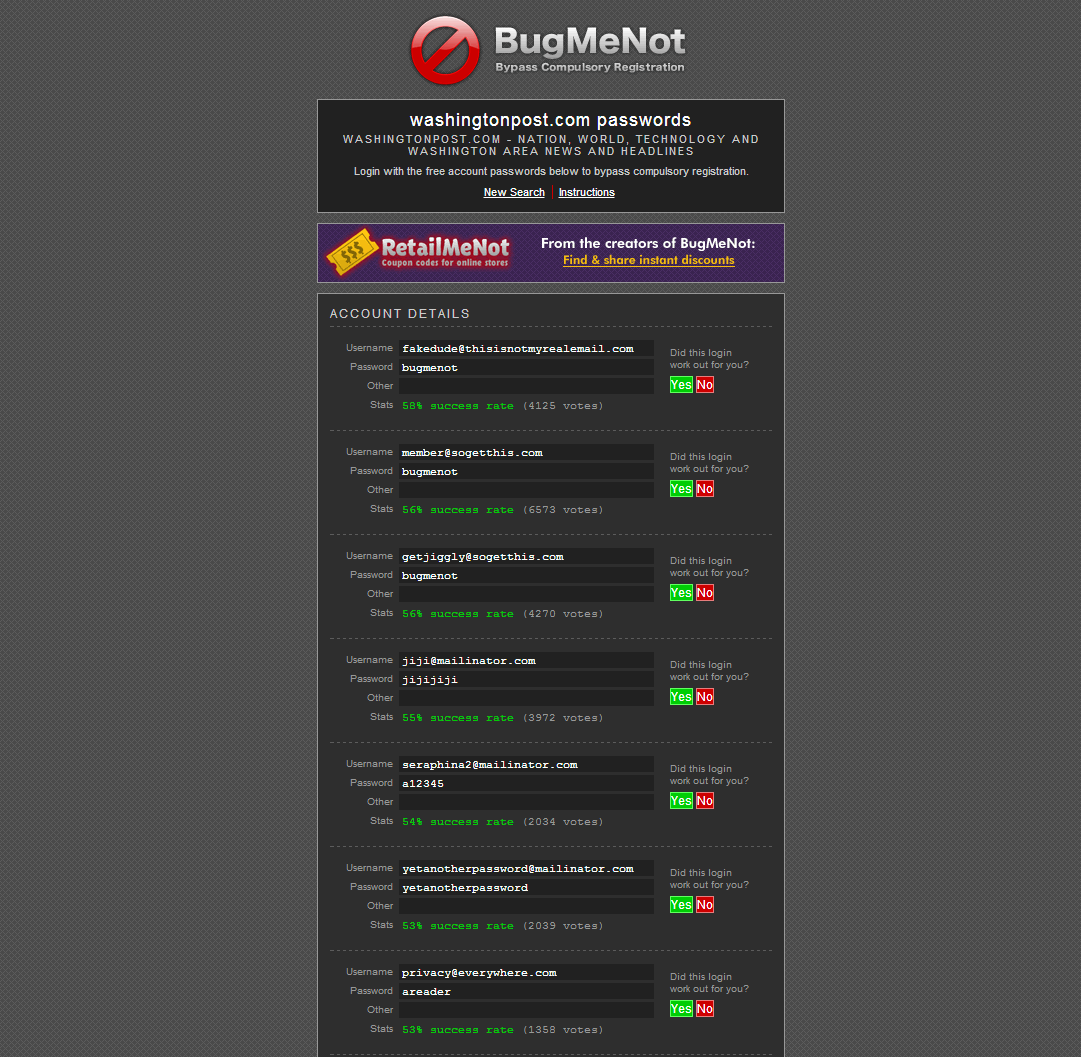
BugMeNot maintains a database of login information you can use to remain anonymous on free websites that require registration.
Finally, this probably doesn't need to be said, but if you log into a website using a username/password combination, the website administrators can track you regardless of whether you're using an anonymizer service. If you need to log in to a website to tap into its full features, see if BugMeNot has a generic login available for the site.
Got it? Good! Let's dig into the various anonymizing tools at your disposal.

Web proxies

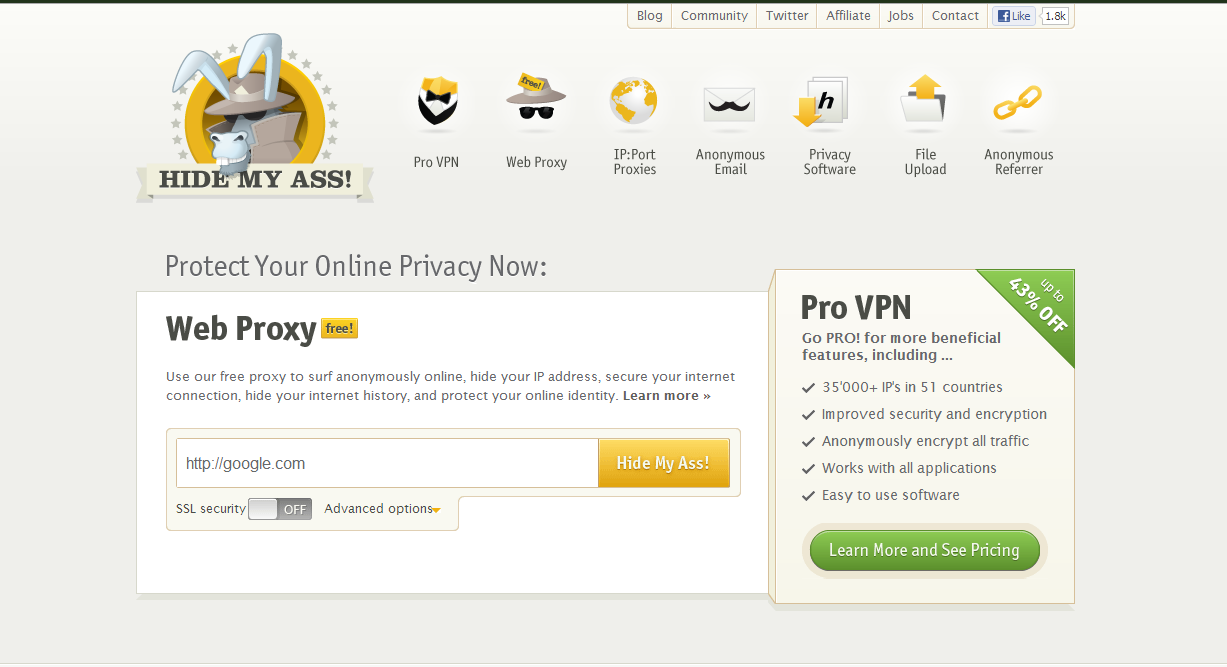
The most basic way to surf websites anonymously is by using Web-based proxies likeProxifyAnonymouse or Hide My Ass. Web proxies are simple and easy to use: Just head to the anonymizing website, type in the URL of the website you want to visit anonymously, and you're off! Some even include advanced features like the ability to encrypt your connection or block ads, cookies, and JavaScript.
Web proxies may be straightforward (and often free), but they have several drawbacks. Data speeds can be atrocious, certain types of content (videos, music, etc.) may be difficult to access, many proxy services interject their own advertising, and some websites simply won't work through a proxy.
Web-based proxies like Hide My Ass claim to keep your IP address and other identifying information anonymous while you're browsing the Web.
Also, while free Web proxies are a dime a dozen and new ones pop up on an almost hourly basis, it's difficult to tell which ones are honeypots set up by bad guys hoping to sneak a peek at your personal information as you share it through their proxy server. In other words, you shouldn't do your online banking or log into a password-protected website when you're using a Web proxy—especially if the connection isn't encrypted via HTTP Secure (denoted by an https:// prefix in your browser's address bar).
The three Web proxies identified above are long-standing and well-trusted, however, and each offers a paid subscriber service that nixes the speed and content complaints.Proxy.org and PublicProxyServers.com also maintain extensive, frequently updated lists of Web proxies.

Manual proxy servers

Some proxy servers don't have a simple website interface, but still allow you to utilize their service for anonymous browsing. You just need to manually configure your browser to connect to the proxy's IP address. As with Web-based proxies, you'll want to shy away from revealing sensitive information or passwords with a proxy server.
Hide My Ass and ProxyNova keep two of the best lists of active proxy servers, with each individual proxy's speed, uptime, country of origin and level of anonymity clearly identified. (You want an anonymous or high anonymous proxy server, of course.)
Once you've picked a proxy server, you'll need to configure your browser to connect to it, a simple procedure that's slightly different depending on your browser. Here's how to do it on the big three:
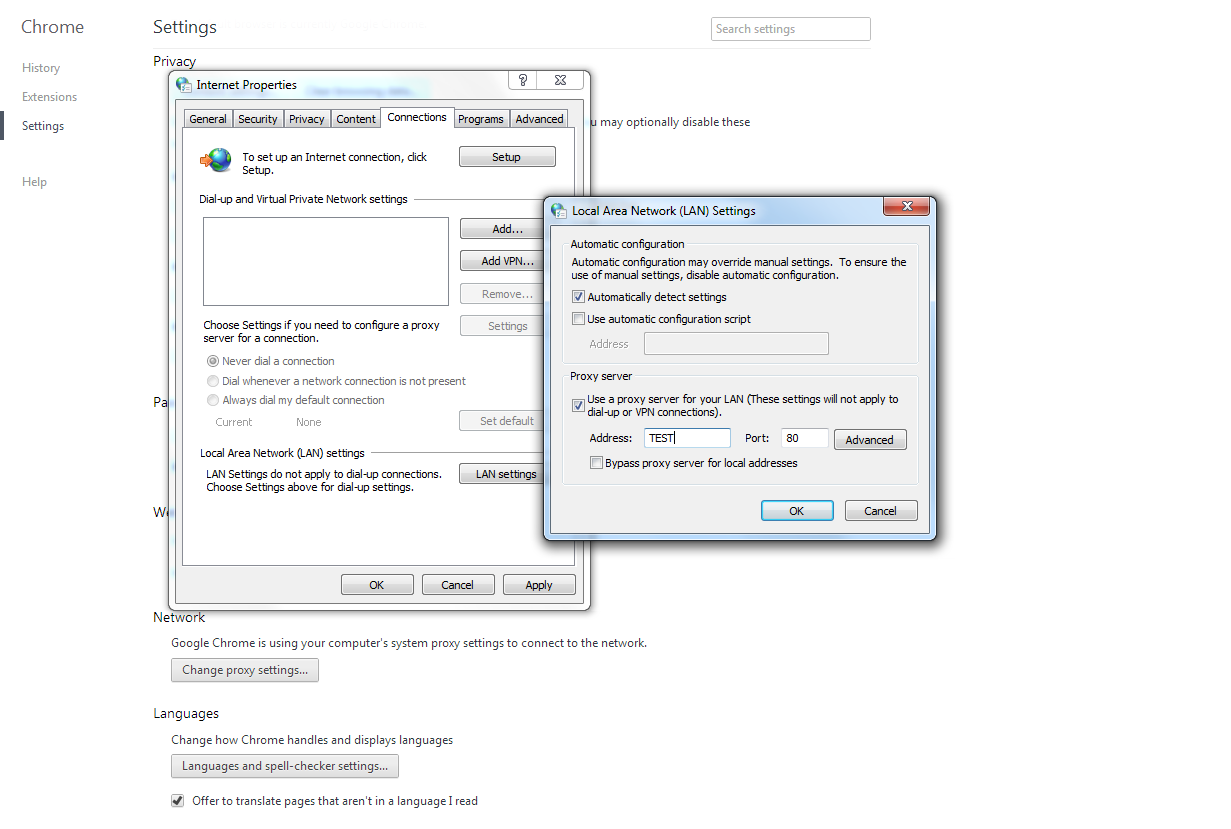
Powerful options to browse the Web through a proxy server or VPN can be found in your browser settings menu.
Internet Explorer 9: Navigate to Tools > Internet Options > Connections tab > LAN Settings. Check the Use a proxy server box and enter the port and IP address info for the proxy server, then click OK. If the proxy you chose uses a secure or SOCKS connection rather than HTTP, enter the settings in the Advanced option.
Firefox: Click the Firefox button, select Options > Advanced Tab > Network Tab, and then click the Settings button in Connections.
Chrome: Click the wrench icon, choose Show Advanced Settings > Change Proxy Settings, and then proceed as you would with Internet Explorer.

Hide your IP address with a VPN

Virtual Private Networks are a good option for people who want an anonymous yet speedy connection and don't mind paying for the privilege. Premium VPNs maintain dedicated proxy servers for their users. Your connection is encrypted and the websites you visit see the VPN's identifying information, not your own.
There are a ton of VPNs out there, and virtually all of them block your identity from third-party websites, but the question an anonymous-minded person wants to ask is, Does my VPN provider keep server logs? TorrentFreak asked several top VPNs that very question and several answered with a resounding "No!" Once you've settled on a provider, you'll need to configure Windows 7 to connect to the VPN.
One of the best and most well-known virtual private networks is The Onion Router, or Tor for short. The Tor network has proven its mettle under fire, helping journalists file reports from countries where Internet access is restricted and allowing citizens to communicate digitally when governments shut down the Internet. Rather than establishing a direct connection between your PC and a proxy server, then connecting the proxy server to the website you want to visit, Tor bounces your data request through several random Tor server relays before pointing it to the final destination. In fact, Tor got its name because like an onion (or an ogre), this network has layers.
The server at each of those layers only knows the identity of the relay that passed it information and the relay it subsequently passes that information along to, with each hop in the chain being encrypted with a totally new encryption key. The robust security measures mean that even if someone is able to intercept one of the data packets en route and crack the encryption, they won't be able to identify you or your final destination. New relay paths are randomly generated every ten minutes or so.
It sounds complicated, but tapping into Tor couldn't be easier. Simply download the Tor Browser Bundle for your operating system of choice (there's even an Android version) and boot up the browser file when you want to surf anonymously. The program handles all the dirty work automatically and even goes so far as establishing an HTTPS connection at your final destination if it's possible. But if you're feeling particularly vulnerable, you can right-click on the Vidalia onion icon in your system tray and selectNew Identity to tell the browser to create a new relay server path.
The Tor Browser doesn't require installation and can be run from a flash drive if you want to carry a copy with you.

Send email anonymously

Now that you know how to cloak your online activities from prying eyes, here's a bonus tip for sending email anonymously for free. See, most of the anonymizers outlined above only play nice with Web browsing, but Anonymouse and Hide My Ass both offer free, basic anonymous email services. The recipient won't know your IP address, actual email address or any other personally identifiable information. With these tips and tools you should be well-equipped to improve your online anonymity; be sure to share your tips with other readers in the comments section and enjoy a safe browsing experience.

8 Invaluable Online Classes for Entrepreneurs

8 Invaluable Online Classes for Entrepreneurs

You have to continually expand your knowledge to succeed as an entrepreneur. Thankfully, educational institutions and technology are making continuing your education more convenient through online course. While there are thousands of  informative and inspiring online courses you can take, here are classes you definitely need to enroll in if you want to be an entrepreneur.

1. How to Build a Startup

This free course over at Udacity is instructed by Steve Blank, serial entrepreneur, educator and developer of the famous customer development methodology. The course is an introduction to the basics of the Customer Development Process which includes learning how to develop and test ideas, how to listen and engage your customers, and how to deliver your product to your audience.
It only takes about a month to complete the eight lessons.
Related: 15 Free Online Learning Sites Every Entrepreneur Should Visit

2. Essentials of Entrepreneurship

Through Coursera, you can learn some of the basic components of entrepreneurship by University of California, Irvine, instructor David Stranden, MBA. It’s an interactive course that consists of approximately four to eight hours of video and reading lessons, along with the occasional quiz.
The course covers entrepreneurial skills and tools, marketing strategy, human resources and accounting.

3. Stanford Innovation and Entrepreneurship Certificate

If you already have work experience, and about a grand to spend, then this online course offered by Stanford University is designed just you. The course was influenced by the spirit of Silicon Valley and will provide students with the tools and strategies to launch their start-up. What’s most appealing about this course is you can hear from successful entrepreneurs and customize the program with classes relevant to you.
The course is self-paced and should be finished within 90 days. After completing the course, you’ll have the official Stanford Innovation and Entrepreneurship Certificate.

4. 21 Critical Lessons for Entrepreneurs

Presented by Jason Nazar, CEO of Docstoc, this two-hour video course includes 21 lessons Nazar has experience himself. Covered in the course is vetting ideas during the early stages of your startup, how to raise money, selecting the right team, and practical growth strategies.
This priceless course is great for potential entrepreneurs and can be taken for free at Udemy. You’ll even get a nifty certification after completion.

5. Startup Funding for Entrepreneurs

Professor Michael R. Pratt from the University of Maryland instructs thisgreat introductory class on when and how entrepreneurs can raise funds. Additional lessons include where to find investors, looking at various funding options, the components of a term sheet, how to perform key valuations, and how to make your pitch to investors.
This four-week course can be taken for free on Coursera.

6. Introduction to Finance

It’s one thing to secure funding for your startup, it’s another beast when it comes to valuing the company. That’s why this course, taught by Gautam Kaul of the University of Michigan, is a must-take for all entrepreneurs. It will teach students how to make the appropriate personal and professional financial decisions by exploring the fundamental principles of valuation.
The 15-week course can be taken on Coursera and includes real-world examples and video lessons.

7. Law and the Entrepreneur

Taught by Esther Barron and Steve Reed of Northwestern University,this course offered at Coursera covers how to choose an entity for your business, selection of a company name and trademark, and protecting intellectual property. It also teaches entrepreneurs how to structure agreements with partners and investors.
The format consists of case studies and four or five short video lectures each week, as well as reading assignments and a quiz.

8. Introduction to Marketing

What’s the point in starting your own business if you can’t market to the right audience? This course is instructed by Barbara Kahn, Peter Fader and David Bell from University of Pennsylvania’s Wharton School of Business, which is constantly ranked as one of the top marketing departments in the world. The course discusses key principles like branding, customer centricity and go-to-market strategies. I used this to learn how to better brand my online business. It's taught me to pay attention to detail and make things stand out